Sea urchin / lamp v2 · 17 Oct 2026
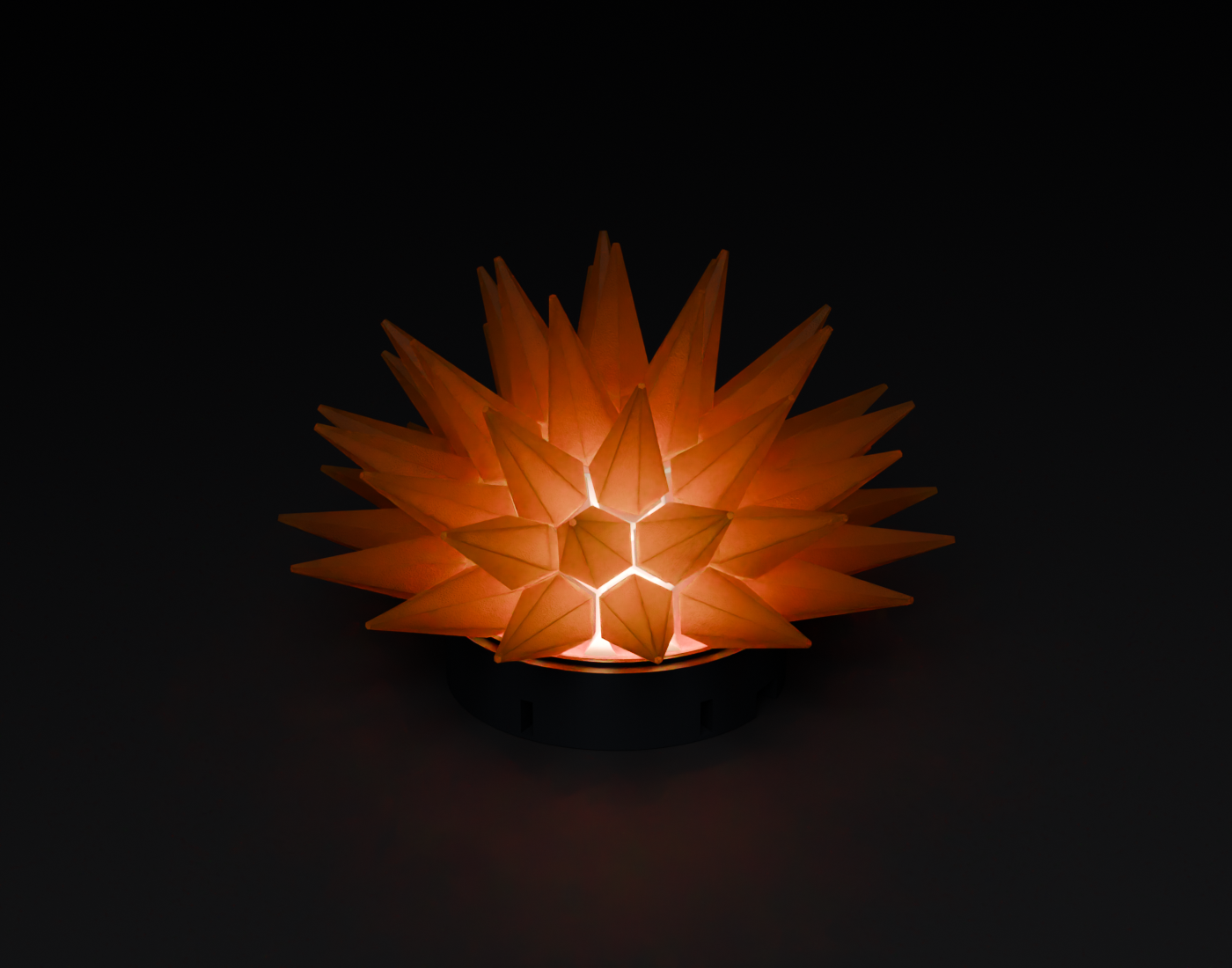
The lamp, switched on.
46 translucent orange PETG spikes with fuzzy skin, glued into a white PLA dome over a warm light puck. All three views below come from one Blender Cycles scene built from the exact v2 meshes from the lamp page. They are illustrations: the materials are estimates, and they have not yet been checked against a photo of the lit lamp.
01 / Rendered
02 / Turn it
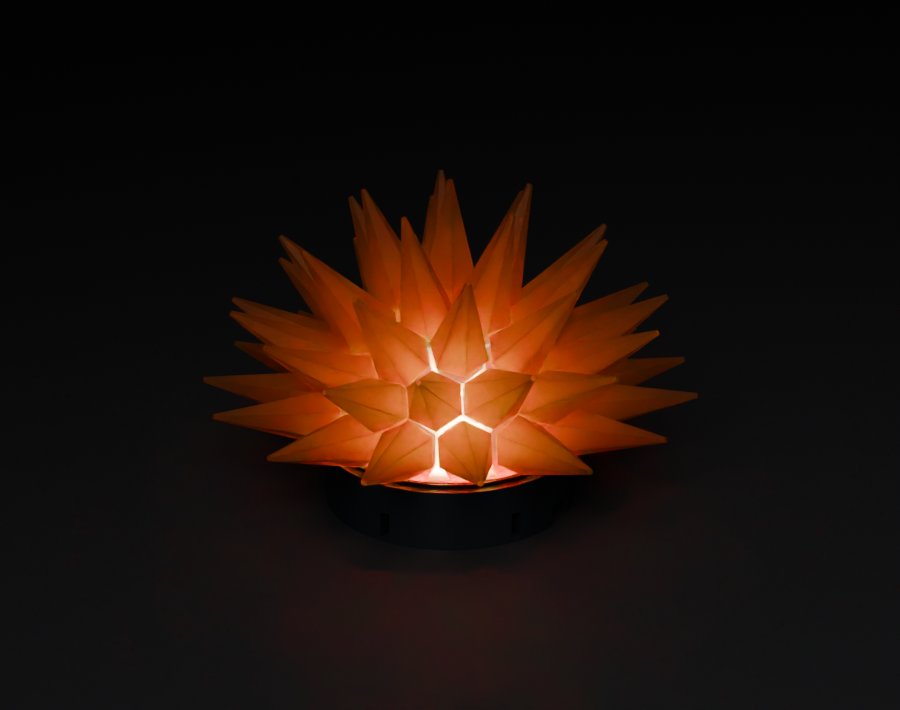
24 Cycles frames, 15° apart: the lamp turns under a fixed camera and room, so every angle is path traced like the image above. Drag across the image or use the slider.
03 / Orbit it
Baked-light 3D model
The render's light is baked into the model's textures: Cycles traced the lighting once, in the same scene, and the model is shown with no real-time lighting. You can orbit and zoom freely, and every angle carries the rendered light. The light itself is fixed, so there is no brightness or explode control. Highlights that depend on viewing angle are baked as seen from straight on, so close up they can look flatter than in the still.
04 / The real lamp
A photo of the finished lamp lit in a dark room, puck at full brightness, will go here next to the render and labelled as the photo. It will also be used to calibrate the render's brightness and colour.
05 / What this is
- Geometry is real. These are the v2 export meshes, posed exactly as on the lamp page (
parts.json). The scene is built bydesigns/sea_urchin/source/presentation/lamp_lit_blender.py. - Light is a guess. The puck emits 150 W/m², set by eye rather than photometry. The spike material approximates Bambu PETG Translucent orange (#FF911A) printed with fuzzy skin (0.3 mm thick, 0.75 mm point distance) over about 0.8 mm walls. Glow evenness, brightness and colour are still to be checked against a photo of the lit lamp.
- Files: lamp_baked.glb (baked textures; view it unlit) · receipt.json · bake_receipt.json (input and output hashes, Blender version, samples)